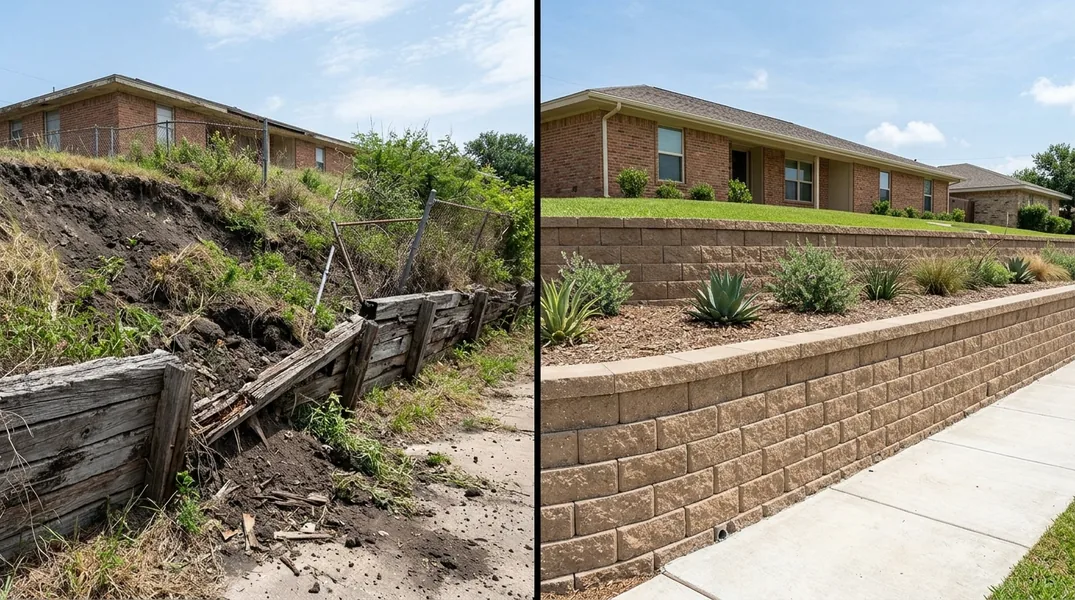
Why Corpus Christi Hurricane Season Is Hard on Retaining Walls
If you live in Corpus Christi, you already know that hurricane season runs from June through November, and it brings more than just windy days. It brings intense, prolonged rainfall that can dump several inches of water on your property in a matter of hours. That water has to go somewhere, and all too often it goes straight into the soil behind your retaining wall.
Most homeowners never think about what happens behind the wall until they see a bulge, a crack, or a lean. The truth is that retaining wall drainage is the single most important factor in whether your wall survives the season. When water cannot escape, it builds up in the backfill soil and pushes against the wall with tremendous force. That force is called hydrostatic pressure, and it is the number one cause of retaining wall failure in coastal Texas.
How Hydrostatic Pressure Retaining Wall Failures Happen
Hydrostatic pressure is simple physics: water weighs about 62 pounds per cubic foot. When rain saturates the soil behind your wall, that water fills every void between soil particles. If the wall was built without proper drainage, the water has nowhere to go and the saturated soil becomes heavy and fluid. It pushes outward against the wall with a force that increases with depth, which is why you often see the bottom of a wall bowing out first.
Over time, this constant pressure weakens the wall's structural integrity. Mortar joints crack, concrete blocks shift, and timber or stone walls can lean or even collapse. In Portland and other low-lying areas around the bay, the problem is even worse because the water table is already high. A wall that looked fine in April can be a serious safety hazard by September if the drainage was never addressed.
The Role of a Retaining Wall French Drain
A retaining wall french drain is the most effective defense against hydrostatic pressure. It is a perforated pipe installed in a gravel-filled trench at the base of the wall, wrapped in filter fabric to keep soil out. When rain saturates the backfill, the water flows into the gravel, enters the pipe, and is carried away from the wall to a safe discharge point. This simple system relieves pressure before it can do damage.
Unfortunately, many older walls in Robstown and across the Coastal Bend were built without a french drain or with one that has long since clogged with sediment. If your wall has no visible drainage outlets, or if you see water pooling at the base after a storm, it is time to have a professional inspect it. Proper Retaining Wall Repair often includes retrofitting a french drain and restoring the backfill so the wall can shed water correctly.
Signs Your Wall Is Losing the Battle Against Rain
Homeowners should inspect their walls after every major rain event. Look for soil washing out from between blocks, which means water is flowing through the wall face instead of through a drain. Check for horizontal cracks, bulging sections, or a lean that wasn't there before. You may also notice sinkholes or soft spots in the yard behind the wall, a sign that the backfill is eroding from the inside out.
If you spot any of these issues, do not wait for the next storm. A small crack can become a collapse in one heavy rain event. For walls that are beyond repair, Retaining Wall Replacement with a properly engineered drainage system may be the safer and more cost-effective choice. In Aransas Pass, where storm surge and heavy rain are common, we often recommend Concrete Retaining Walls because they handle saturation and pressure far better than wood or dry-stacked stone.
Retaining Wall Repair Near Me: When to Call a Pro
Some homeowners try to patch cracks or add a coat of sealant, but that does not address the water behind the wall. If you are searching for retaining wall repair near me, look for a contractor who understands local soil conditions and storm patterns. A proper evaluation includes checking the drainage, the backfill, and the wall's structural capacity, not just the visible surface.
At Corpus Christi Retaining Wall, we inspect the entire system and give you honest recommendations. Whether you need a new french drain, a full Retaining Wall Installation, or targeted repairs, we build for the long haul. Call (361) 600-4114 to schedule a free estimate before the next storm season catches you off guard.
Protecting Your Investment: What to Budget
Drainage work and repairs vary widely depending on wall length, height, and access. A simple french drain retrofit may cost a fraction of a full replacement, but every project is different. We encourage homeowners to ask for a written scope of work and a clear explanation of how water will be managed. You can review general pricing on our website, then call for a site-specific assessment.
Think of drainage as insurance. The few hundred dollars you spend on a french drain can save you thousands in wall replacement and landscape damage. After hurricane season, the last thing you want is a collapsed wall and a flooded yard. Take action now, and your wall will stand strong through the next round of Texas rain.
Looking for a professional retaining wall contractor in Corpus Christi? Corpus Christi Retaining Wall responds fast for all your retaining wall needs.
Get a Free QuoteOur services: Retaining Wall Installation · Retaining Wall Repair · Retaining Wall Replacement