



Leaning & Collapsed Wall Repair in Corpus Christi
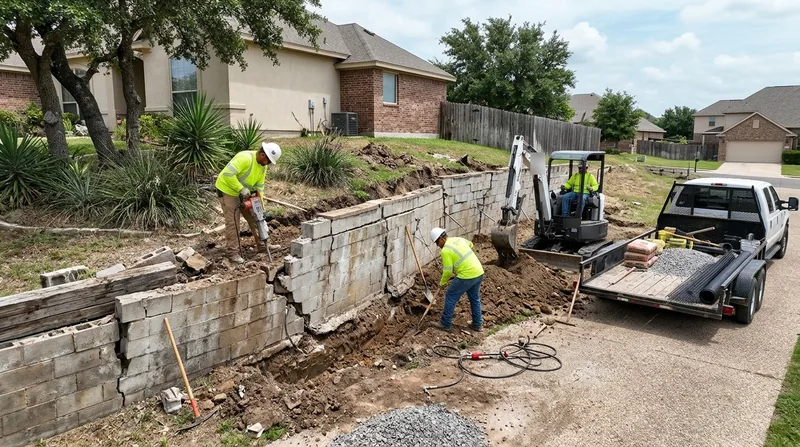
Corpus Christi sits on the flat Coastal Bend plain, and the ground under your wall tells the story before you ever see the lean. Inland lots in Calallen and along Oso Creek sit on dark shrink-swell clay that swells with every hurricane downpour and shrinks hard in the dry stretches. Toward Flour Bluff and the island, the soil turns to loose sand over a high water table, and salt air works on mortar and rebar year round. That combination is why Leaning & Collapsed Wall Repair in Corpus Christi is the call we get most, usually after a wall has already started to bow at the top or drop a course of block. We stabilize what can be saved, correct the drainage that caused the failure, and rebuild what cannot. If your wall is still standing but moving, start with our retaining wall repair page and call (361) 600-4114.
Why Walls Lean and Collapse on the Coastal Bend Plain
Almost every leaning wall we open up in Corpus Christi has the same root cause: water pushing from behind, not bad block. The clay inland holds water like a bowl, so hydrostatic pressure builds behind a wall that has no working drain. Bayfront and creek lots on the bluff above Ocean Drive add slope creep and saturated sand to the equation. Old railroad tie walls near Del Mar and the bluff district rot from the bottom up and quietly give way.
- Clay soils in Calallen and Robstown swell after rain and shove the wall face outward.
- Clogged weep holes and missing gravel backfill trap water behind poured concrete and CMU walls.
- Loose sand near Flour Bluff and Padre Island lets footings settle unevenly and tilt a whole wall.
- Salt air and humid Gulf light break down mortar joints and accelerate rot in timber walls.
- Hurricane downpours overwhelm undersized drains and cause sudden partial collapses.
We inspect the wall, the soil, and the drainage path together, because fixing the lean without fixing the water is a temporary patch.
Key info: A block wall on a Southside lot near Lamar Park was bulging 3 inches at the top after two wet springs. The drain was clogged with clay fines, and the wall had no gravel behind it. We relieved the pressure, reset the drain, and anchored the face instead of tearing the whole wall out.
Walls above roughly 4 feet from the footing, or walls carrying a driveway or structure, usually need a permit and sometimes engineered drawings. Confirm the threshold with the City of Corpus Christi building department before work starts: City of Corpus Christi.
How We Stabilize a Leaning Wall in Corpus Christi
We do not guess at a repair from the curb. The first step is finding out whether the footing has moved, whether the soil is saturated, and whether the wall is tied to anything. On sand lots in Flour Bluff that means probing the base; on clay lots in Robstown it means opening the face and reading the water line. Then we choose the lightest repair that will actually hold.
- We excavate behind the wall and relieve the trapped water before we touch the face.
- We install tieback anchors or helical anchors into stable soil to pull the wall back to plumb.
- We rebuild the drainage layer with washed gravel, filter fabric, and working weep holes.
- We replace cracked block or concrete sections and re-point mortar joints damaged by salt air.
- We rebuild the wall from the footing up when the base has failed or the wall is past anchoring.
Each repair ends with a drainage test, because a wall that still holds water will lean again within a season.
Key info: A canal front home on Padre Island had a segmental block wall that dropped 4 inches after a storm surge soaked the sand behind it. We pulled the wall back with anchors, rebuilt the gravel drain, and replaced the two bottom courses. The homeowner avoided a full rebuild and kept the original wall face.
For walls on the bluff or on steeper creek lots, anchoring alone is not enough, and we bring in slope stabilization and erosion control to hold the ground above the wall.
Repair Approaches We Use on Corpus Christi Walls
Not every leaning wall needs the same fix. A poured concrete wall at a driveway in Kings Crossing behaves differently from a boulder edge on a bayfront lot. This table shows how we match the approach to the wall and the ground under it.
| Approach | Description | Best for |
|---|---|---|
| Tieback anchoring | Anchors driven into stable soil pull the wall face back to plumb and hold it. | Bulging or tilting walls with an intact footing. |
| Drainage correction | New gravel, filter fabric, and weep holes relieve hydrostatic pressure behind the wall. | Walls leaking clay water or showing wet spots. |
| Partial rebuild | We remove and reset the failed courses and re-point the remaining wall. | Walls with cracked block but a sound base. |
| Full rebuild | We remove the wall, correct the footing, and rebuild with proper drainage. | Collapsed walls or failed footings on sand. |
| Tie wall replacement | We pull rotted railroad ties and replace them with block or concrete. | Old timber and tie walls near the bluff. |
Leaning & Collapsed Wall Repair Cost in Corpus Christi: What to Expect
Most leaning wall repairs in Corpus Christi start at From $2,500, and that figure covers a modest wall with a drainage correction and anchoring. The price climbs with wall height, how much block has to be replaced, and how hard it is to get equipment behind the wall. A canal front lot on Padre Island with tight access costs more to work than an open driveway wall in Portland.
Collapsed walls almost always cost more because the footing has to be rebuilt and the soil behind it reworked. Old railroad tie walls near Del Mar add disposal costs. On clay lots, we may need to undercut and replace the soil before we rebuild. We give you a written scope with the repair, the drainage work, and the disposal listed separately so you can compare bids fairly.
Get two or three estimates before you commit, and ask each contractor what they will do about the water behind the wall. Our full pricing overview breaks down the ranges by wall type and repair scope.
What to Look for When Hiring a Retaining Wall Contractor Near Corpus Christi
Ask for the license and insurance certificate before anyone touches the wall, and confirm the policy covers retaining wall work, not just general landscaping. Call two recent references in your part of town, ideally a wall on the same soil type. Ask whether the contractor pulls permits when the wall is over the height threshold or supports a driveway. Check HOA rules before you approve a rebuild, because some subdivisions restrict wall height and material. And walk the wall with the estimator so you hear the diagnosis, not just the price.
We document the wall condition before and after, and we hand over the drainage details so the next owner knows what is behind the face. Reach us through our contact and free estimate page or call (361) 600-4114.
Leaning & Collapsed Wall Repair in Corpus Christi: Pricing Guide
| Service | Price | Details |
|---|---|---|
| Leaning wall stabilization with tieback anchors | Starting at $2,500 | Covers excavation, anchor installation, and drainage correction on a low wall with open access. |
| Partial rebuild of failed block or concrete courses | Starting at $3,800 | Includes removal of failed courses, new block, re-pointing, and a rebuilt gravel drain layer. |
| Full rebuild after collapse | Starting at $6,500 | Removes the wall, corrects the footing, rebuilds with drainage, and hauls off debris. |
| Railroad tie wall replacement | Starting at $4,200 | Pulls rotted ties, disposes of them, and rebuilds in block or concrete with new drainage. |
| Complex or large-scale job | On estimate | Tiered walls, tight canal access, or engineered designs need an on-site look first. |
| Estimate | Free | Response within 24 hours at (361) 600-4114, with no obligation to book. |
Indicative pricing, the exact cost depends on square footage, finish, and site access. Free personalized estimate within 24h at (361) 600-4114.


