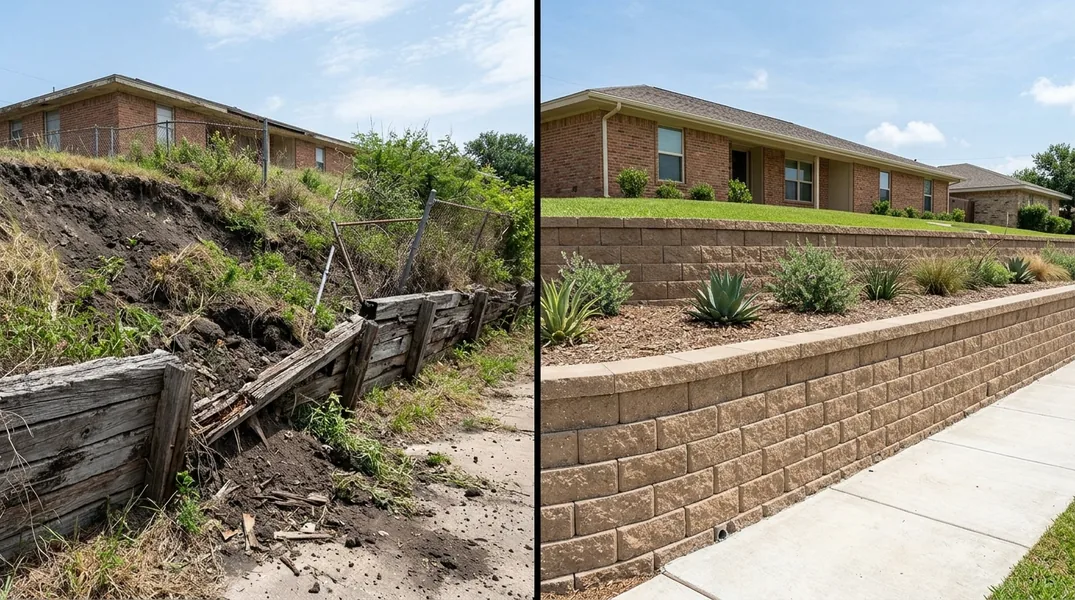
Why Corpus Christi's Soil and Salt Air Change the Material Conversation
Most retaining wall guides are written for inland suburbs with stable, well-drained dirt. Corpus Christi is a different animal. The ground here swings between expansive clay that swells after a heavy rain and sandy, shifting soils near the bay and the barrier islands. Add constant salt-laden humidity and intense summer sun, and you get an environment that punishes generic building advice.
Clay is the big one. When it absorbs water it expands with enough force to bow a poorly designed wall outward. When it dries, it shrinks and leaves voids behind the structure. Sandy soils near the waterline behave in the opposite way: they drain fast but lose bearing strength and can wash out from under a footing. Salt air then attacks anything metallic, from rebar to fasteners, accelerating rust and eventual spalling. Choosing a material without accounting for all three forces is how walls fail early in this region.
The good news is that the right materials handle these conditions beautifully when they are paired with proper drainage, base preparation, and reinforcement. Below we break down the four most common options we install across the Coastal Bend and where each one genuinely shines.
Concrete Retaining Walls: The Heavyweight for Expansive Clay
Poured Concrete Retaining Walls are the strongest choice for tall walls and for lots where clay soils push hard. A reinforced concrete wall can be engineered to resist lateral pressure that would crack a lighter system, and it holds its shape for decades. For homeowners dealing with a steep grade or a wall that needs to hold back a significant load, concrete is often the most reliable answer.
The catch is corrosion. Salt air will find any exposed steel, so quality concrete work means proper cover over the rebar, air-entrained mixes that survive freeze-thaw and salt spray, and a sealed finish. Aesthetics are another consideration: plain concrete can look industrial, though textured form liners and stains can soften it considerably. Concrete also requires a solid footing and, in clay, a well-designed drainage plane behind the wall to relieve hydrostatic pressure. Done right, it is a lifetime investment.
Block and Segmental Retaining Walls: Flexibility That Fits the Coast
A Retaining Wall Installation using a block retaining wall or a segmental retaining wall system is the most popular choice for residential projects in this area, and for good reason. These interlocking units are designed to flex slightly with soil movement instead of cracking, which is a real advantage when clay shifts through wet and dry seasons. They also drain well because water passes through the joints rather than building up behind a solid face.
Modern segmental systems come in dozens of colors and textures, so you can match the look of your home or hardscaping. They work for walls from knee-high garden terraces up to taller engineered structures, provided the design includes proper geogrid reinforcement and a gravel drainage core. The one thing to watch is the quality of the block itself: cheap units with high absorption rates can degrade in salt air. We specify dense, low-absorption concrete units rated for coastal exposure, and we backfill with clean gravel so the wall breathes.
Boulder Retaining Walls: Natural Character for Sandy and Sloped Lots
A boulder retaining wall brings a rugged, natural look that fits the coastal landscape perfectly, and it is an excellent performer on sandy or sloped properties. Large, heavy stones are set into the grade and rely on their own mass plus careful placement to hold soil. Because they are solid stone, they resist salt air and moisture without rusting or spalling the way some manufactured products can. They also allow water to move through the gaps, which reduces pressure buildup.
Boulders are not a fit for every site. They need space, since each stone is large, and they work best on lower walls where the natural look is the goal. On tall walls or tight lots, engineered systems are usually safer and more space-efficient. Boulder walls also demand skilled equipment operation and a good eye for interlocking stones so the wall does not shift. For the right property, though, a boulder wall is both durable and genuinely attractive, and it ages gracefully in the coastal climate.
Retaining Wall Installation Near Me: Matching Material to Your Property
There is no single best material for every lot in the Coastal Bend. A homeowner in Portland with a sandy slope may get the best result from boulders, while a property in Robstown sitting on expansive clay often needs the structural strength of concrete or a reinforced segmental system. The right answer depends on soil type, wall height, drainage, and how you want the finished space to look.
This is where a local installer earns their keep. We evaluate your soil, slope, and drainage before recommending a material, and we build in the details that coastal walls need: gravel backfill, drainage pipe, filter fabric, and corrosion-resistant hardware. If an existing wall is failing, we can assess whether Retaining Wall Repair makes sense or whether a full Retaining Wall Replacement is the smarter long-term move. We also serve nearby communities like Aransas Pass with the same coastal-focused approach.
If you are comparing options and want to understand pricing before you commit, reach out for a free estimate. Call Corpus Christi Retaining Wall at (361) 600-4114 and we will walk your property, explain the trade-offs honestly, and recommend the material that will actually last in our clay, sand, and salt air.
Looking for a professional retaining wall contractor in Corpus Christi? Corpus Christi Retaining Wall responds fast for all your retaining wall needs.
Get a Free QuoteOur services: Retaining Wall Installation · Retaining Wall Repair · Retaining Wall Replacement